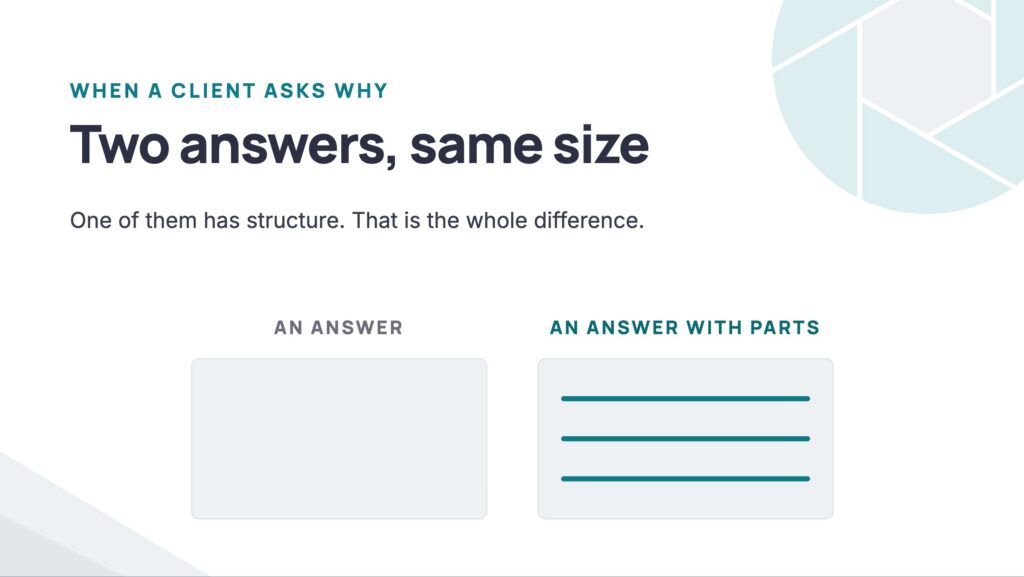
A client calls and says reimbursement is down. They want to know why, and they want to know whether it is the payer or it is you.
Most firms answer with an anecdote. Something about what they have seen across other accounts, delivered with appropriate confidence, which the client hears as a version of not knowing.
The firms that answer differently are not working harder on that call. They have a data asset the others do not, which is the argument the guidance for billing companies and RCM firms is built on.
- Clients do not leave over a missed claim. They leave when they stop believing the firm knows something they do not.
- An anecdote about other accounts is heard as an absence of evidence.
- A benchmark marked Tight or Wide, with year-over-year trend, is a different conversation entirely.
- Your book compounds the advantage, because every client’s contributed claims deepen the benchmarks used for the rest.
The Call, and Why the Usual Answer Fails
You know the shape of it. Reimbursement dropped on a payer, the facility noticed before you flagged it, and the honest answer available to you is that payers have been tightening.
That answer is frequently true and it is still the wrong thing to say, because it is unfalsifiable. The client cannot check it, cannot act on it, and cannot distinguish it from a firm covering for itself.
What changes the call is evidence the client could in principle verify. Not a stronger assertion, a checkable one.
What a Checkable Answer Looks Like
When a client asks why their Blue Cross reimbursement moved, the useful response is a benchmark carrying its year-over-year trend, resolved to alpha prefix and home plan, drawn from a pool spanning 250 payer groups and 20 states and growing.
The Blues resolution is doing real work in that sentence. A brand-level figure would blend independently operating plans, which is why resolving Blue Cross by home plan is the difference between an answer and an average.
And the figure has to carry its own support, or you have replaced one unfalsifiable claim with another. What Tight or Wide measures is what lets you say how much weight the number holds without overstating it.
A benchmark shows what comparable adjudicated claims have paid. Presenting it to a client as what they should have been paid is an overstatement, and it is the one that will eventually be checked.
It Changes How You Prospect, Not Just How You Retain
The same lookup runs before a contract exists. Pull benchmark distributions for a prospect’s payer mix and walk into the pitch already knowing what their top five payers actually pay in their state, by level of care.
That is a different meeting. You are not asking what their pain is, you are describing it with numbers they recognise, which is the fastest credibility available in a category where every firm promises clean claims.
Public data will not get you there. CMS is candid in its own guidance on using price transparency information about what those files support, and the shape they publish in is not the shape a per diem question needs. The longer version is in what a payer paid other providers.
Across the Whole Book, Not One Account
The eligibility side has to work at volume, because a firm runs checks across dozens of facilities rather than one. Carve-out detection, prior-authorization indicators, and cost-share detail on every check, with the expected reimbursement attached to the result rather than looked up separately.
Check history in the account is the part that shows up in your margins. Re-verification at volume is where staff time disappears, and starting fresh every time a patient calls back is a cost nobody line-items.
The rate expectation is also worth recording against each admission so variance becomes measurable across the book, which is the loop in expected versus actual applied to clients rather than to sites.
Why the Book Itself Is the Asset
Every client’s contributed claims deepen the benchmarks you use for every other client. A ten-facility book builds an intelligence asset a two-facility shop cannot match, and it keeps compounding as long as the book does.
The contribution discount scales with exactly the volume you already have, up to 25 percent at 2,000 or more accepted lines. Pricing is built for the model as well: pooled seats, unlimited facilities on every plan, and custom terms for books that do not fit standard volume.
Contribution is de-identified, which is the part a client will ask about and the part worth being precise on. The federal de-identification standard at 45 CFR 164.514 is the reference, and no facility’s identity is attached to a benchmark another customer sees.
- Answer a reimbursement question with a figure the client could check.
- Resolve Blues claims to the home plan before quoting a trend.
- Pull a prospect’s payer mix before the pitch, not after.
- Record the rate expectation per admission across the book.
- Do not answer with what you have seen across other accounts.
- Do not present a benchmark as what the client should have been paid.
- Do not quote a brand-level Blues figure to a client who can check it.
- Do not treat rate intelligence as a reporting feature rather than the retainer.
The Short Version
Clean claims are table stakes. What keeps a client is the sense that you know something they do not, and rate intelligence delivered before they ask is the clearest evidence of it available.
What Do I Say When a Client Asks Why Reimbursement Dropped?
Show a benchmark marked Tight or Wide, with its year-over-year movement for that payer, state, and level of care, resolved to the plan that adjudicates. A checkable figure changes the conversation more than a more confident assertion does.
Can I Use This Before a Client Signs?
Yes. Pulling benchmark distributions for a prospect’s payer mix lets you describe their situation in their own numbers during the pitch rather than discovering it during onboarding.
Will My Clients' Data Be Exposed to Other Firms?
No. Contributed claims are de-identified, and no facility’s identity is attached to a benchmark another customer sees. Minimum-volume floors also keep specific arrangements from surfacing through thin aggregates.
Does a Bigger Book Actually Help?
Yes, in both directions. The contribution discount scales with volume, and every client’s contributed claims deepen the benchmarks used for the rest of the book.
Start free with 15 historical searches at signup. No credit card required.
Get 15 Free Searches