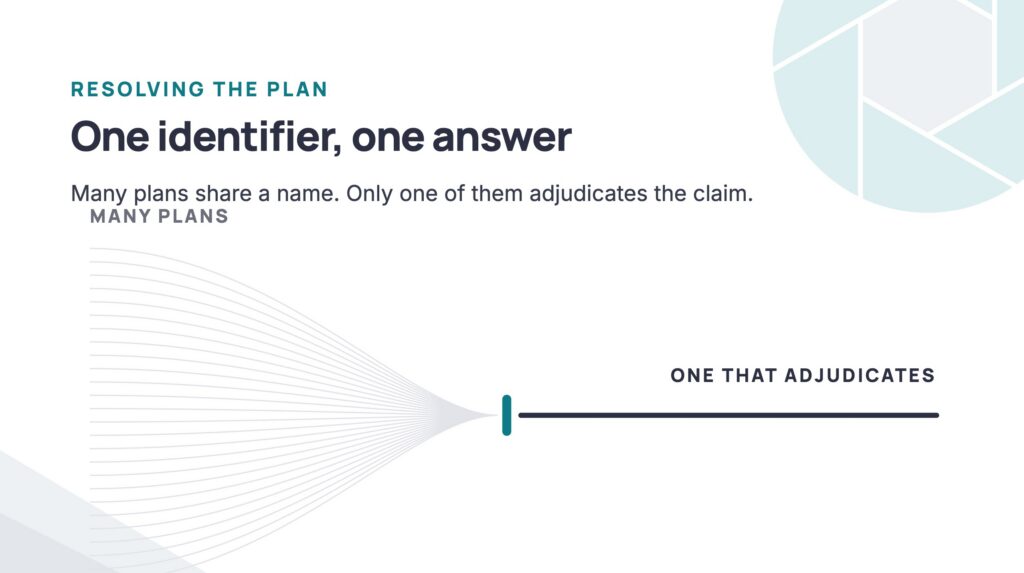
Ask what Blue Cross pays for residential treatment and the only honest first answer is a question. Which Blue Cross.
The logo is shared. The pricing is not. Two members holding cards with the same mark can be adjudicated by different organizations under different reimbursement structures, and a figure that averages across them describes neither.
That is why a reimbursement benchmark search will not return a Blue Cross result without an alpha prefix. It is not a missing feature. It is the system declining to answer a question that has not been made answerable yet.
- Blue Cross Blue Shield is a federation of independently operating plans, not a single payer.
- The member’s home plan can determine how a claim is priced and adjudicated.
- The alpha prefix on the card is the identifier that resolves which plan that is.
- A brand-level average blends plans that share a logo and nothing else that matters.
A Federation, Not a Payer
Blue plans operate independently of one another. They hold their own contracts, run their own networks, and set their own reimbursement structures within their own territories.
What that means for a claim is that the entity making the decision may not be the one whose name is most visible on the card. A member treated far from home is common in behavioral health, which makes this an everyday problem rather than an edge case.
The consequence for a rate figure is direct. A number built by pooling every plan carrying the mark is an average across organizations that never agreed to price anything the same way.
The Identifier That Resolves It
The letters at the start of a member identification number on a Blue Cross Blue Shield card. It identifies the member’s home plan, which is the entity whose terms generally govern how the claim is priced and adjudicated.
PayerLenz resolves Blue Cross claims by alpha prefix and home plan before they enter a benchmark. That resolution happens on the way in rather than at the point of a search, so a result for one plan is never diluted by claims from another that shares only a brand.
The prefix travels with the member identifier through the eligibility exchange, which runs on the X12 transaction set standard. It is on the card and it is in the response, which means the information needed to ask the question properly is usually already in front of the person asking it.
Why the Search Returns Nothing Without It
A search for a Blue brand with no prefix has two options. It can blend every plan carrying that mark into one figure, or it can decline.
Declining is the correct behaviour and it is deliberate. A blended figure would look like an answer, would be quotable, and would describe no plan that exists, which is worse than an empty result that names the reason.
This is the same discipline that shows up in a trust score describing its support. A system that will not say more than its evidence carries is the only kind whose confident answers mean anything.
Resolving the home plan tells you which organization’s terms are likely to govern. It does not tell you what a specific claim will be allowed, and no amount of plan-level precision makes a benchmark a guarantee of payment.
What This Changes at Intake
Capture the full member identifier, prefix included, at the first conversation. It takes no additional time, it is one field, and it is the difference between a question that can be answered and one that cannot, which is why it belongs in the script an admissions team works from.
Then read the network position and the benefit structure against the plan that actually owns them. A plan’s provider network is defined by the plan, not by the brand, so an out-of-network position under one Blue plan tells you very little about another.
If the response also flags a behavioral health carve-out, the administrator question stacks on top of the home-plan question, and both need resolving before a number is quoted. That sequence is worked through in the carve-out that answers wrongly.
Why This Is Worth the Extra Field
Every rate source that publishes Blue Cross as a single row has made a choice to look complete rather than to be right. It is the easiest way to appear to have broader coverage than you do.
The alternative, which is narrower and honest, is the one that survives a facility checking a figure against its own remits. That trade is the same one described in what a payer paid other providers, where the sources that look most comprehensive are frequently the least usable.
- Capture the alpha prefix with the member ID at first contact.
- Resolve the home plan before quoting any Blue Cross expectation.
- Check for a carve-out on top of the home-plan question.
- Treat an empty result as information rather than a gap.
- Do not read a Blue Cross brand-level average as a rate for your member’s plan.
- Do not assume a network position carries across Blue plans.
- Do not record the member ID without the prefix.
- Do not reuse a figure from a different Blue plan because the logo matched.
The Short Version
Blue Cross is a brand shared by organizations that price independently. The prefix is what turns an unanswerable question into an answerable one, and it is already on the card.
Why Does a Blue Cross Search Need an Alpha Prefix?
Because the prefix identifies the member’s home plan, and the home plan generally governs how the claim is priced and adjudicated. Without it, any figure would be an average across independently operating plans.
Where Do I Find the Alpha Prefix?
At the beginning of the member identification number on the card, and in the eligibility response. It is usually already captured, just not always recorded.
Is a Blended Blue Cross Rate Ever Useful?
Rarely, and never for a specific admission. It can describe a brand in aggregate, but it does not describe the plan that will adjudicate the claim in front of you.
Does Resolving the Home Plan Tell Me What the Claim Will Pay?
No. It tells you whose terms are likely to apply, which is what makes a benchmark comparable. What a specific claim is allowed remains a separate matter.
Start free with 15 historical searches at signup. No credit card required.
Get 15 Free Searches