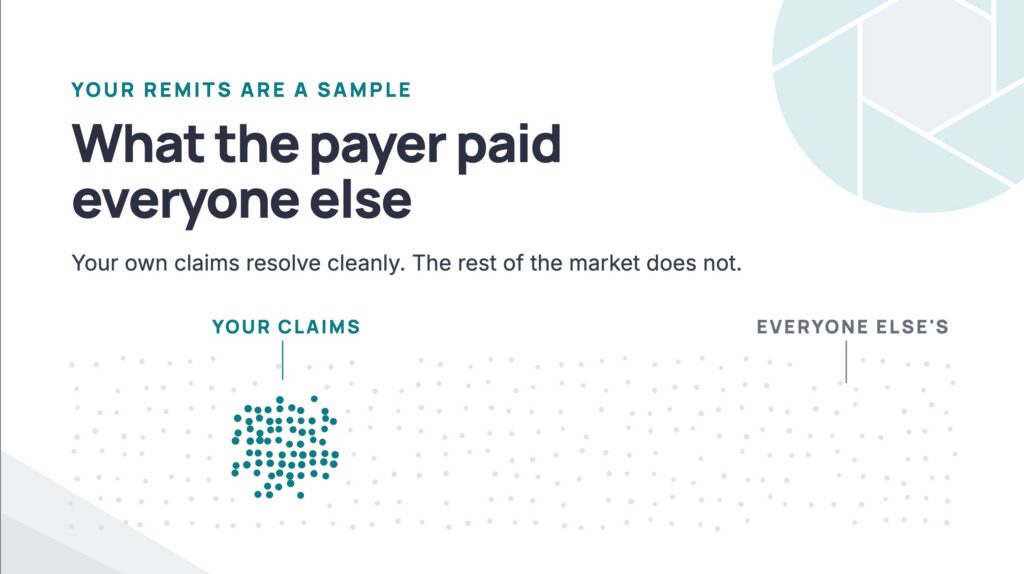
A facility director asks what a payer pays for PHP in their state. The billing manager can answer it for their own facility, from their own remits. Nobody in the building can answer it for anyone else’s.
That gap is the whole problem. Your own history tells you what you have been paid, which is not the same question as what the payer pays. If something in your billing or your plan mix has been costing you, your own data will confirm the shortfall rather than reveal it.
There are three places to look, and only one of them was built to answer this. PayerLenz reimbursement benchmarks exist because the other two stop short.
- Your remittance history answers what you were paid, not what the payer pays.
- Payers publish machine-readable pricing files under federal rules, but those files were built for a different question.
- Some states operate all-payer claims databases, and their coverage and lag vary widely.
- Pooled adjudicated claims from many facilities are the only route that answers the question directly.
Start With Your Own Remits, Then Notice Where They Stop
Your remittance history is the cleanest data you will ever hold. It is specific to your payers, your levels of care, and your state, and nobody has to explain its provenance to you.
Comparing billed, allowed, and paid across your own closed claims is worth doing before anything else, and an AR dashboard built on your history makes that comparison continuous rather than a quarterly reconstruction.
Then notice the limit. A single facility’s history is a sample of one, and it cannot tell you whether a rate is normal or whether you have simply been accepting it. Every facility that has ever been underpaid for years had internally consistent data the whole time.
What Is Publicly Available, and What It Was Built For
Health plans are required to publish pricing data. Under the Transparency in Coverage final rule, most group health plans and issuers post machine-readable files covering in-network negotiated rates and out-of-network allowed amounts and billed charges.
A structured data file, published on a schedule, intended to be read by software rather than by a person. Plans publish them under federal price transparency rules. They are frequently large enough that opening one on a laptop is not a realistic plan.
The Transparency in Coverage fact sheet sets out what each file has to contain and who has to publish it. That is genuine progress, and it is not the same as an answer.
The files are organised around billing codes and plan structures, not around levels of care. Nothing in them separates residential from PHP from IOP the way a behavioral health facility thinks about an admission, and nothing in them tells you which pricing basis produced a given amount.
CMS has also published guidance on using the pricing information these files contain, which is worth reading precisely because it is candid about what interpretation the data does and does not support.
Some states operate all-payer claims databases as well. Where one exists it can be genuinely useful, but coverage differs state by state, the reporting lag is often measured in years, and behavioral health is rarely broken out at the level a facility needs.
Pooled Claims Answer the Question the Others Do Not
The only way to see what a payer pays other providers is to look at claims other providers have already had adjudicated. That means pooling, and pooling only works if enough facilities contribute for any single one to disappear inside the aggregate.
PayerLenz is built on more than 500,000 adjudicated claims across 250 payer groups in 20 states and growing. Every figure is drawn from claims that generated an EOB, not from a survey and not from a fee schedule.
What comes back is a distribution rather than a single number. The most-likely rate starts from the all-time median and moves toward the recency-weighted median, with the P25, P50, P75, and P90 spread around it, so you can see the range real claims occupy instead of an average that describes none of them.
Reading it well means knowing what separates the claims inside it. The reimbursement methodology behind a claim is what makes two figures from the same payer differ by a multiple, and PayerLenz keeps each methodology separate rather than blending them.
A benchmark describes what comparable adjudicated claims have paid for a given payer group, state, and level of care. It is not a prediction about your next claim and it is not a guarantee of payment.
What Changes at Intake
The point of knowing what a payer pays other providers is not curiosity. It is that the number arrives before the admission decision rather than after the remit, which is the only point at which it can change anything.
That matters differently depending on who is asking. An admissions director needs it on the call, a billing director needs it to reconcile against, and a multi-facility operator needs every site reading the same number, which is why the solutions by role are framed the way they are.
It also changes vendor evaluation. Most tools in this category confirm coverage and stop, which is the distinction the honest comparison with VerifyTX works through in detail.
- Compare your own billed, allowed, and paid before assuming a rate is normal.
- Record the plan and the level of care at intake, not just the payer name.
- Read the distribution and the claim count together, never the headline figure alone.
- Treat a thin sample as a signal to verify rather than as a number to quote.
- Do not treat a single facility’s history as a market rate.
- Do not quote a blended average across pricing methodologies.
- Do not promise a family a figure drawn from a benchmark.
- Do not assume a public pricing file answers a level-of-care question.
The Short Version
Your remits tell you what you were paid. The public files tell you what plans have agreed to, in a shape built for a different question. Adjudicated claims from other facilities tell you what the payer actually pays, and that is the only one of the three that settles the argument.
Can I Find Out What a Payer Paid Another Facility?
Not for a named facility, and no reputable source will give you that. What you can see is what comparable adjudicated claims have paid across many facilities for the same payer group, state, and level of care, with the claim count behind it.
Do the Federal Price Transparency Files Include Out-of-Network Amounts?
Yes. Plans publish out-of-network allowed amounts and billed charges alongside in-network negotiated rates. The files are organised around billing codes rather than levels of care, so they do not answer a per diem question directly.
Why Is an Average the Wrong Number to Ask For?
Because claims priced under different methodologies sit in the same payer group. Their average lands in a gap where few real claims fall, which is why the distribution and its claim count matter more than the midpoint.
How Many Claims Make a Benchmark Worth Quoting?
Enough that the figure is not describing one arrangement. Thin combinations are filtered out rather than presented as market benchmarks, and every published figure carries its claim count.
Start free with 15 historical searches at signup. No credit card required.
Get 15 Free Searches