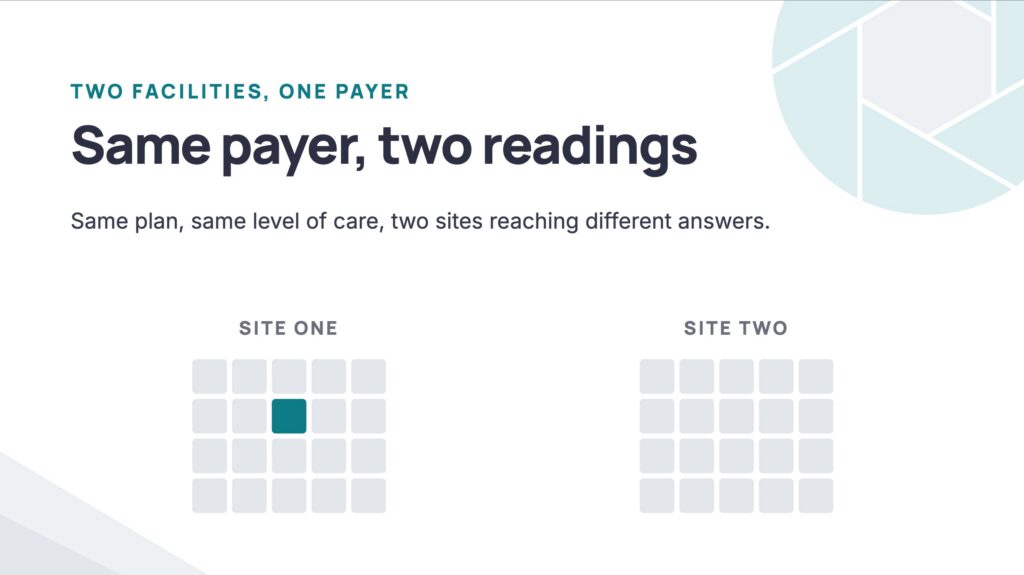
Two of your facilities admit a patient on the same plan, at the same level of care, in the same week. One reads the case as marginal and takes it carefully. The other reads it as comfortable and takes it without a second look.
Both reads came from experience. Neither came from the same information, and only one of them was right.
That gap is not a training problem. It is what happens when payer knowledge lives in people rather than in a system, which is the argument the guidance for multi-facility groups is built around.
- Across states, payer behavior stops being a fact and becomes a matrix.
- Tribal knowledge does not transfer between sites, and every acquisition resets it to zero.
- A regional rate difference should show up as a filter setting, not as a surprise one site absorbed.
- Standardising rate intelligence is the piece you can centralise on day one.
The Problem Is Not Any One Site
Every operator has a strongest location and a weakest one, and the instinct is to treat the gap as a people problem. Sometimes it is. More often the two sites are working from genuinely different information and reaching defensible conclusions from it.
The same national payer that reimburses a level of care well in one market can pay substantially less two states over, under a different reimbursement methodology, through a different Blues home plan. None of that is visible from inside one building.
So the veteran rep at the flagship is not wrong about their market. They are wrong about the market their colleague is working in, which is a different failure and one that no amount of experience fixes.
Why It Compounds Rather Than Averages Out
Knowledge held in people leaves with them. A rep who reads a payer well is an asset that walks out the door, and the site that had them reverts to guessing.
Acquisitions make it worse rather than better. A new site arrives with its own accumulated habits, and the learning curve starts at zero while the group’s reported numbers already include it.
Geography compounds it again. Payer networks are defined plan by plan rather than by brand, and a plan’s provider network in one state tells you very little about the same insurer’s arrangement in another.
Make the Matrix Explicit
The fix is not a better spreadsheet or a monthly call. It is that the variable which differs between sites becomes a field somebody can filter on.
State and payer-group filters on every reimbursement benchmark turn a regional rate difference into a setting rather than a surprise. The difference still exists. It stops being a discovery.
Blues plans deserve particular attention here, because a group operating across states will routinely see members whose home plan sits somewhere else entirely. Why that changes the number is worked through in resolving Blue Cross by home plan.
Standardising the information does not standardise the outcome. Two sites reading the same benchmark can still see different results, because the benchmark describes what comparable claims have paid rather than what any claim will pay.
One Number, Read the Same Way
Standardising the figure is only half of it. Sites also have to read it the same way, which means the confidence signal has to travel with the number rather than being stripped in a summary.
A result carrying strong support and a result carrying thin support should produce different behaviour at intake, and what a trust score measures is the shared vocabulary that makes that behaviour consistent across locations.
Government rate references vary by locality too, which is part of why a single national figure is the wrong shape for a multi-state group. The CMS fee schedules that several pricing methodologies anchor to are published with geographic variation built in.
Roll Up Without Losing the Detail
Group-level reporting fails in one of two ways. Either it aggregates until nothing is actionable, or it never aggregates and leadership reads eleven separate reports.
What works is billed, allowed and paid at group level with the claim-level detail still reachable underneath, so a paid percentage that slipped at one site can be opened rather than inferred. That is the loop described in expected versus actual, run across locations instead of one.
Facilities are unlimited on every plan and seats are pooled across the whole customer group, which matters more operationally than commercially. Opening location number six should not mean that site starts with worse information than the flagship.
- Put every site on the same benchmark source before standardising anything else.
- Carry the confidence signal into every location’s workflow.
- Filter by state and payer group rather than holding a national average.
- Onboard acquisitions onto the standard rather than absorbing their habits.
- Do not treat variance between sites as a training problem by default.
- Do not let one site’s payer knowledge stay in one person’s head.
- Do not compare locations on a metric none of them can open.
- Do not apply a flagship market’s read to a new geography.
The Short Version
Process consistency gets harder with every location. Rate intelligence is the one piece that can be centralised on day one, and doing it early is what stops the eleventh site from being the eleventh learning curve.
Why Do Two of Our Sites Read the Same Payer Differently?
Usually because they are reading different markets. The same national payer can price a level of care differently by state, by methodology, and by Blues home plan, and none of that is visible from inside one building.
Is This a Training Problem?
Sometimes, but less often than it looks. Two experienced teams working from genuinely different information will reach different conclusions, and both can be defensible.
What Should a New Acquisition Standardise First?
The rate source. It is the piece that can be centralised immediately, it does not depend on rewriting anyone’s workflow, and it stops the new site from starting with worse information than the rest of the group.
Does One Standard Mean One Number for Every Site?
No. It means one source and one way of reading it. The numbers should still differ by state, payer group, and level of care, because the underlying payer behavior does.
Start free with 15 historical searches at signup. No credit card required.
Get 15 Free Searches