It is 4:45 on a Friday. A family is on the phone, the clinical need is obvious, and the plan is an out-of-network product nobody on the team has seen before.
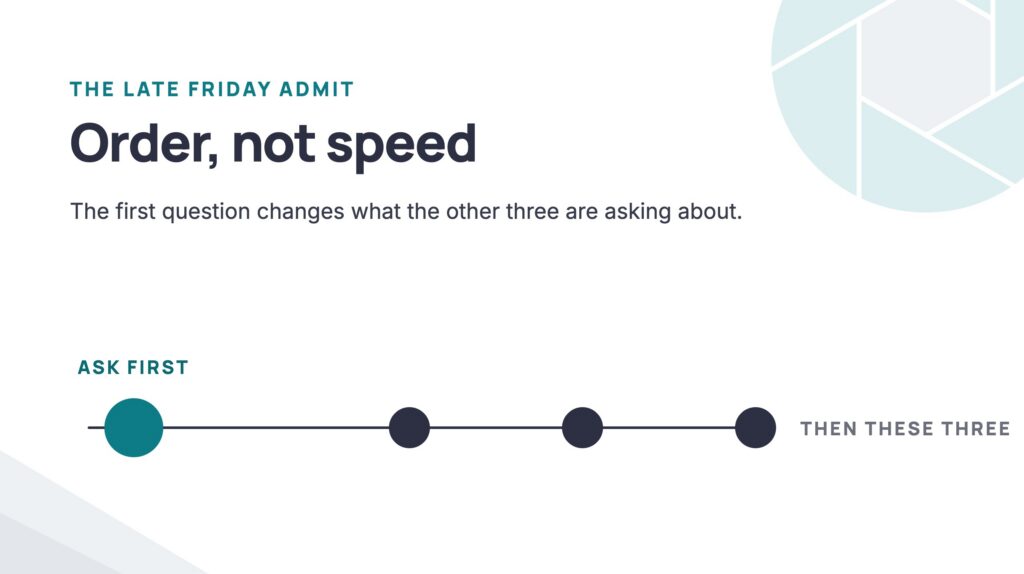
Whoever picks up has about ten minutes and four questions to get through. Getting them in the right order matters more than getting through them quickly, because the answer to the first one changes what the other three are asking about.
This is the call the guidance for the admissions team taking the call is built around, and it is the one where a good process is worth more than a good instinct.
- Ask who administers the benefit before asking what the benefit is.
- A coinsurance percentage is a share of an amount the verification does not disclose.
- What comparable claims have paid is a separate lookup from whether coverage is active.
- The decision to make a payer call is a threshold, not a judgement call in the moment.
Why the Order Matters
Every one of these questions can be answered accurately and still leave you with the wrong expectation, if it was answered about the wrong plan or applied to the wrong base.
Working them in order is what stops that. Each answer narrows what the next question is actually asking, and skipping ahead is how a clean-looking verification turns into a surprise on the remit.
One. Whose Coverage Is This?
Coverage active is not the first answer you need. The first answer you need is which organization will price the claim, because behavioral health benefits are frequently administered by someone other than the medical plan on the card.
Run a real-time eligibility check and read the carve-out indicator before anything else. If one is flagged, the useful next step is rerunning against that administrator rather than continuing on a response from a plan that will not adjudicate.
The full version of this failure, and how to catch it, is in the carve-out that answers wrongly. On a Friday afternoon the short version is enough: check the flag, then proceed.
Two. Eighty Percent of What?
The response comes back with a coinsurance percentage and a deductible position. That feels like the answer and it is half of one.
Out-of-network coinsurance is a share of the allowed amount, not of what you bill. The allowed amount is the number the verification does not carry, and the gap between billed and allowed is where most bad expectations are born.
So the honest reading at this point is a structure, not a figure. You know how the cost will be split. You do not yet know what it will be split from.
Three. What Have Comparable Claims Paid?
This is the lookup most teams do not have and the one that turns a coverage answer into a revenue expectation. A reimbursement benchmark search returns what comparable adjudicated claims have paid for that payer group, state, and level of care.
Read the distribution rather than the midpoint, and read the support before either. The trust score on that result tells you whether you are holding a number you can plan against or one that should stay directional until somebody verifies it.
A narrow range on strong support ends the call. A wide range on thin support is not a failure of the lookup, it is the lookup telling you the answer to question four.
Four. Does This One Need a Call?
Set the threshold before Friday, not during it. A payer call is worth placing when the electronic response came back thin, when a carve-out is flagged but the administrator is unclear, when the out-of-network structure will not resolve from the response, or when the admission is valuable enough that being wrong is expensive.
Where one or more of those is true, a live VOB worked by phone is the correct next step. Where none of them is true, the electronic answer is the answer and the call is a habit rather than a control.
The transactions underneath all of this are standardised, which is why the process can be a checklist at all. CMS documents them under administrative simplification, and that consistency is what makes a four-question workflow portable across payers.
None of these four answers commits a payer to anything. Together they produce a well-supported expectation, which is a different thing from a promise and should be described to a family as such.
What to Say While the Family Is Still on the Phone
Say what is confirmed and say what is not, in that order. Coverage status and cost-share structure are confirmed. The amount the cost share applies to is an expectation drawn from claims history.
Give a range rather than a figure, and say why it is a range. Families in crisis are not helped by false precision, and a number that later moves by a multiple costs more trust than a range ever did.
Then say what happens next and when. If the case is going to a payer call, tell them that, and tell them when they will hear back.
After the Call, Write It Down
Record the expected range, the support behind it, and the plan characteristics against the admission. Not in someone’s notes, and not as a single number.
That record is what makes the next Friday easier. Comparing it against billed, allowed, and paid on the closed claim is the loop described in expected versus actual, and it is how a team learns which payers it reads reliably and which ones need a call every time.
- Check the carve-out indicator before reading anything else.
- Give the family a range and the reason it is a range.
- Escalate on the threshold you set in advance.
- Record the expectation against the admission the same day.
- Do not apply a coinsurance percentage to billed charges.
- Do not quote a figure from a prior admission that felt similar.
- Do not decide whether to call based on how the last case went.
- Do not promise a family an amount their plan will pay.
The Short Version
Whose plan, what the share applies to, what comparable claims have paid, and whether this one needs a human. Four questions, in that order, and the first one is the one most teams ask last.
What Should I Check First on an Unfamiliar Out-of-Network Plan?
Which organization administers the behavioral health benefit. If it is carved out to another administrator, every subsequent answer needs to come from that administrator rather than from the medical plan.
Can I Give a Family a Number on the First Call?
You can give a range with its basis, and you should say plainly that it is an expectation drawn from claims history rather than a commitment from the plan. A single figure invites a precision the data does not support.
When Is a Payer Call Worth the Delay?
When the response is thin or contradictory, when a carve-out is flagged without a clear administrator, when the out-of-network structure will not resolve, or when the value of the admission makes being wrong expensive.
What if There Is No Time to Do All Four?
Do the first one. Knowing which organization will price the claim is the answer that most changes the others, and it is the fastest of the four to get.
Start free with 15 historical searches at signup. No credit card required.
Get 15 Free Searches