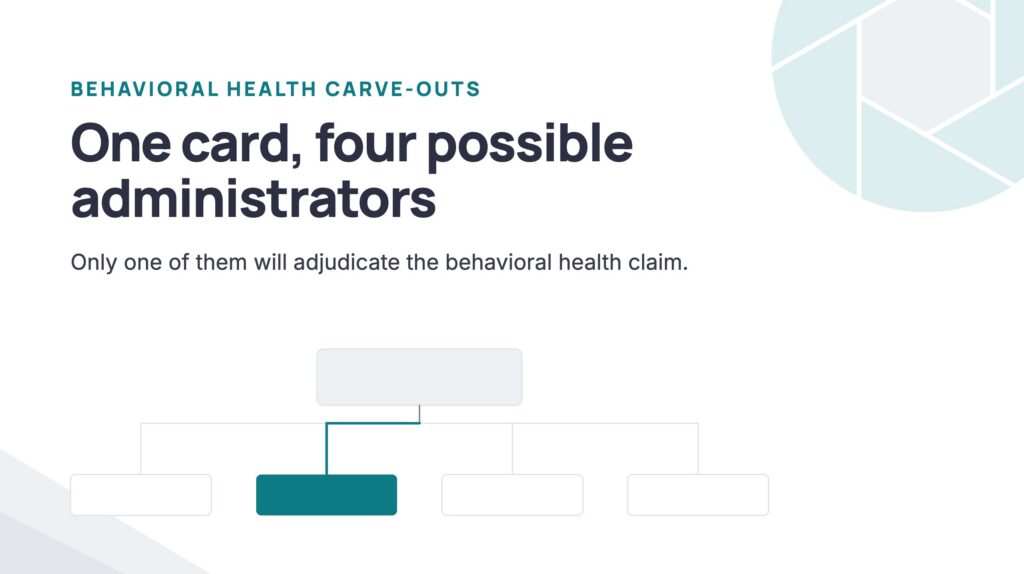
The eligibility response comes back clean. Coverage active, deductible mostly met, out-of-network benefits in place. Admissions passes it to the family as a yes.
Six weeks later the claim comes back from an organization nobody on the call had heard of, priced under rules nobody checked. The coverage answer was correct. It was answered by a plan that was never going to adjudicate the claim.
That is a carve-out, and it is the most common way an accurate verification still produces a wrong expectation. Detecting it is one of the checks that PayerLenz real-time eligibility runs on every response.
- A carve-out means behavioral health benefits are administered by a different organization than the medical plan.
- The member’s card usually names the medical plan, not the administrator that will price the claim.
- A clean coverage response from the wrong plan is still the wrong answer.
- The fix is rerunning the check against the carve-out administrator before anyone commits to a number.
What a Carve-Out Is, and Why the Card Does Not Show It
Carve-outs exist because behavioral health has historically been managed separately, with its own network, its own authorization rules, and its own pricing. None of that is visible to a family holding a card.
An arrangement in which a plan’s mental health and substance use benefits are administered by a separate organization from the rest of its medical benefits. The member keeps one card and one plan name. The behavioral health claim goes somewhere else.
It is not visible to an admissions rep either, unless something in the workflow is looking for it. The card names the plan the employer bought. It does not name the organization that will decide what the admission is worth.
The Names That Turn Up
The same administrators appear again and again in behavioral health carve-outs: Optum, Magellan, Beacon and Carelon, ComPsych, and Evernorth. Seeing one of those names in a response is the signal that the claim is going somewhere other than where the coverage answer came from.
PayerLenz scans the payer response for known behavioral health administrators and flags the carve-out with its source, so the flag is traceable rather than a guess. That is the difference between knowing a carve-out is indicated and suspecting one.
What the Electronic Response Can and Cannot Tell You
An eligibility check is a structured request and response between your system and the payer, governed by the X12 transaction set standard that the industry runs on. It returns coverage status, cost-share structure, and a set of indicators.
What it does well: active or inactive, deductible and out-of-pocket totals in and out of network, behavioral health cost-share, prior-authorization requirements, and carve-out indicators. That is a real answer to a real question.
What it does not carry is the price. The transaction was never designed to transmit what a claim will be allowed, which is why a coverage answer and a revenue expectation are two different lookups unless something puts a reimbursement benchmark beside the response.
Parity rules are part of why behavioral health benefits get this much separate machinery in the first place. The CMS parity guidance sets out the requirement that mental health and substance use benefits be treated comparably to medical and surgical benefits, which is the backdrop every carve-out arrangement operates against.
Rerun the Check Against the Administrator That Will Pay
Detecting a carve-out is only useful if the next step is short. When one is flagged, the useful move is rerunning the check against the carve-out administrator rather than proceeding on a response from a plan that will not adjudicate the claim.
Keeping both checks threaded under the original matters more than it sounds. Six weeks later, when somebody asks why the expectation was what it was, the record shows the first response, the flag, and the corrected answer in order.
A carve-out flag tells you which organization is likely to administer the benefit. It does not tell you what the claim will be allowed, and no eligibility response does.
When to Stop Checking and Make the Call
Electronic checks handle most cases well. Some do not resolve cleanly, and knowing which ones is what protects the time of an admissions team on the phone.
Order a call when the carve-out is indicated but the administrator is unclear, when the response comes back thin or contradictory, and when the admission is valuable enough that being wrong is expensive. Submitting it to a live VOB worked by phone keeps the rep on admissions instead of on hold.
Below that threshold the call usually does not pay for itself. Treating every case as a phone case is how a verification team becomes the bottleneck on admissions.
- Check for a carve-out on every out-of-network behavioral health verification.
- Rerun against the administrator before quoting anything to a family.
- Record which entity answered, not just what the answer was.
- Escalate to a live call when the administrator is indicated but unnamed.
- Do not treat the plan name on the card as the adjudicating entity.
- Do not read a clean coverage response as a pricing answer.
- Do not rely on a rep remembering which payers carve out.
- Do not requote a stale check when the patient calls back weeks later.
The Short Version
A carve-out does not make the verification wrong. It makes it an answer about the wrong organization, which is worse, because nothing about the response looks like a warning. It is the second way a correct verification produces a wrong expectation, alongside the question a VOB never answers.
How Do I Know if a Plan Has a Behavioral Health Carve-Out?
The payer response carries indicators, and the presence of a known behavioral health administrator is the strongest signal. The member’s card is not reliable evidence, because it usually names the medical plan only.
Does a Carve-Out Change What the Claim Will Pay?
It changes which organization sets the terms, which frequently changes the amount. What a comparable claim has actually paid under that administrator is a separate question from whether coverage is active.
Should I Still Run the Original Check?
Yes. The first response establishes coverage and cost-share structure, and it is worth keeping on the record. The second check answers who will price the admission.
Is a Carve-Out the Same as Prior Authorization?
No. A carve-out is about who administers the benefit. Prior authorization is a requirement that may apply either way, and both can show up on the same response.
Start free with 15 historical searches at signup. No credit card required.
Get 15 Free Searches