The clinical case is strong and the financial case is not. At the rate this payer usually allows for this level of care, the admission does not carry itself, and the reflex is to take it anyway or turn it down.
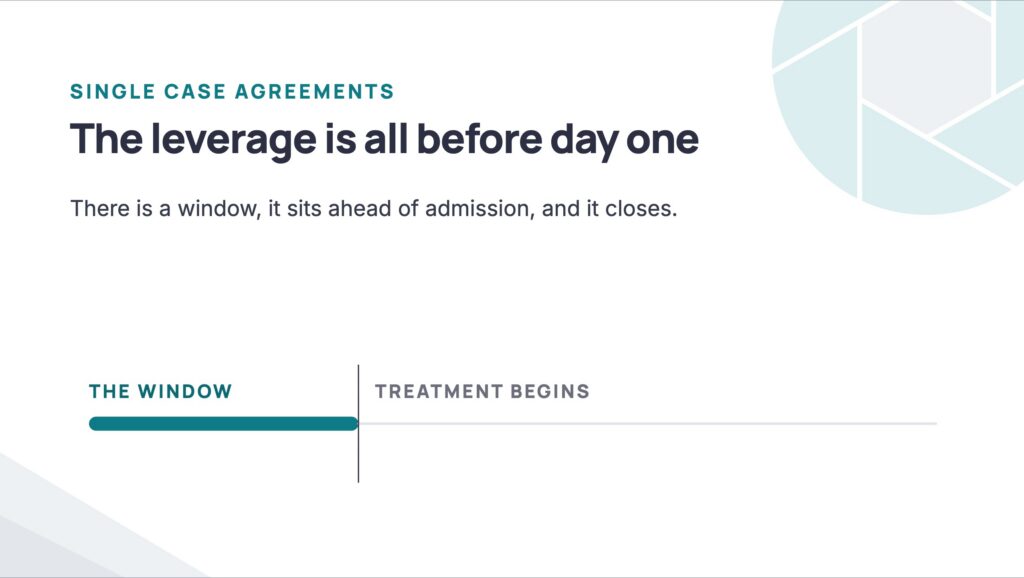
There is a third option, and most facilities are worst at it precisely when it matters most. A single case agreement is negotiated in the window before treatment starts, which is the same window everyone is busiest.
Whether it is worth attempting is a question with an answer, and it is one a billing director can work out in about ten minutes if the rate information is already on the desk.
- A single case agreement is a one-off arrangement covering one patient, negotiated outside the standard network relationship.
- The common grounds are a genuine network gap, continuity of care, or programming the network cannot supply.
- Knowing what the payer already allows others for that level of care is what turns a request into a negotiation.
- The window is before treatment starts, not after the claim is denied.
What an SCA Is, and When One Gets Entertained
A negotiated arrangement between a payer and an out-of-network provider covering one specific patient, rather than a standing contract. It sets terms for that admission only and does not make the provider part of the payer’s network.
Payers entertain them for practical reasons rather than generous ones. The most common is that the plan’s provider network cannot actually supply the care the member needs, at the level of care they need it, within a reasonable distance.
Continuity of care is the second common ground. A member already in treatment, or with an established relationship, presents a clinical argument the payer has to weigh against the cost of an interruption.
The third is programming the network genuinely does not have. Behavioral health produces these more often than most specialties, which is part of why carve-outs, level-of-care authorization rules and SCAs cluster in this field the way they do.
Three Things to Check Before You Ask
Is the clinical need documented and specific? A request that describes a category of care is weaker than one that describes why this member needs this level of care now. The documentation exists either way; the question is whether it has been assembled.
Is there a real network gap? Check it rather than assume it. A payer that can name three in-network options at the right level of care within range is not going to negotiate, and finding that out during the call is worse than finding it out before.
Do you know what this payer already pays? This is the one most facilities skip, and it is the one that changes the conversation from a request into a negotiation.
Bring the Rate, Not Just the Request
A request with no number in it invites the payer to supply the number. That is how facilities end up agreeing to terms below what the same payer routinely allows other providers for the same level of care in the same state.
Opening with an expectation drawn from a reimbursement benchmark search changes the footing. You are not asking what they will pay, you are proposing terms consistent with what comparable adjudicated claims already show.
Check the support behind the figure before you use it that way. The trust score on that result determines whether you are carrying a firm number or a directional one, and a directional number should be presented as a range rather than a position.
A single case agreement is a negotiation. Nothing about a benchmark, a documented clinical need, or a network gap obliges a payer to agree, and none of it predicts the outcome of a specific request.
What to Have Ready Before the Call
Verification first, and the right verification. If the plan carves behavioral health out to another administrator, the negotiation belongs with that administrator, which is why a real-time eligibility check that flags carve-outs is the step before anything else.
Then the authorization picture, the documented clinical rationale, the network-gap evidence, and the rate expectation with its supporting claim count. Five items, none of which take long individually, and all of which are painful to assemble at 4:00 on a Friday.
Where the electronic response leaves the out-of-network detail blank, a live VOB worked by phone is worth ordering before the negotiation rather than after it, because the negotiation depends on knowing what the standing terms actually are.
Know Your Own Floor
Decide the number below which the admission does not work before you are in the conversation. That figure comes from your own cost structure and expected length of stay, not from what feels reasonable in the moment.
The method is the same one used for any admission, described in estimating revenue per admission. The difference is that in an SCA the number is something you say out loud rather than something you record.
Parity rules are part of the backdrop here. The CMS parity guidance sets out the requirement that mental health and substance use benefits be treated comparably to medical and surgical benefits, which is the frame within which network adequacy arguments sit.
- Establish the network gap before you claim one exists.
- Open with a rate expectation and its supporting claim count.
- Confirm which entity administers the benefit before negotiating.
- Set your walk-away number before the call, not during it.
- Do not ask what the payer will pay and wait for a figure.
- Do not open a negotiation after the claim has already been denied.
- Do not present a thin benchmark as a firm position.
- Do not negotiate with the medical plan when the benefit is carved out.
The Short Version
An SCA is a negotiation that most facilities enter without the one thing that makes it a negotiation. The clinical case gets you the conversation. The rate evidence determines what comes out of it.
When Should I Request a Single Case Agreement?
Before treatment starts, while the payer still has a decision to make. Once the admission has happened and the claim has been denied, the conversation becomes an appeal rather than a negotiation.
What Makes a Payer More Likely to Agree?
A documented clinical need tied to this specific member, a network that cannot supply the level of care within a reasonable distance, and terms that are consistent with what the payer already allows comparable providers.
Should I Name a Number First?
Generally yes, if the number is supported. A request with no figure in it invites the payer to set the terms, and their opening position is rarely what they routinely allow other providers.
Does an SCA Make Us In-Network?
No. It covers one patient and one episode. It does not create a standing contract or change how the payer treats your other claims.
Start free with 15 historical searches at signup. No credit card required.
Get 15 Free Searches