Most facilities can produce an estimate of what an admission will be worth. Very few can tell you whether last quarter’s estimates were any good.
That is the whole difference between a number that improves and a number that just gets repeated. An estimate nobody checks is a habit, not a forecast.
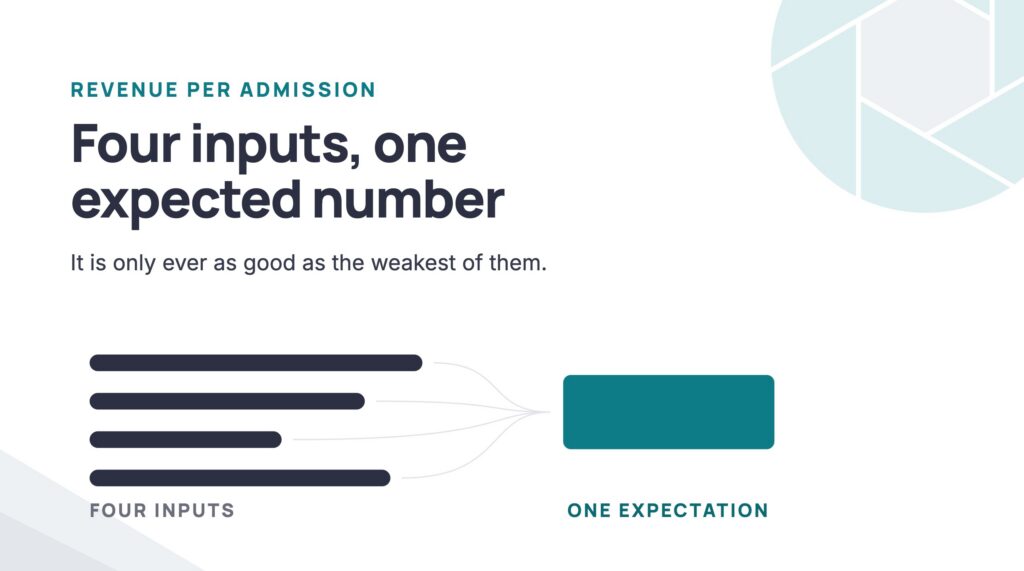
The arithmetic itself is not hard. It takes four inputs, and the loop that makes it worth doing closes on the PayerLenz AR dashboard weeks later, when the claim either lands where you said it would or does not.
- Revenue per admission is a range built from four inputs, not a single figure.
- Coinsurance applies to the allowed amount, so a benefit percentage alone cannot produce an estimate.
- Record the estimate at intake or there is nothing to compare the remittance against.
- An estimate that is never checked cannot get better, and most never are.
The Four Inputs
An expected allowed amount per day. This comes from a reimbursement benchmark search covering that payer group, state, level of care, and reimbursement methodology, read as a distribution rather than a midpoint.
The support behind it. The trust score on that result determines how wide a range you should carry and whether the case needs a live verification before anyone relies on the figure.
Patient responsibility. The eligibility response returns deductible and out-of-pocket totals, met and remaining, plus behavioral health cost-share. That is what separates what the payer issues from what the plan recognises.
Expected length of stay. This one is yours. Your own historical length of stay by level of care is better evidence than any external figure, and it is the input most facilities already have.
Why a Benefit Percentage Cannot Do This Alone
A verification returning 80 percent after deductible feels like an answer. It is a share, and a share needs something to be a share of.
Coinsurance applies to the allowed amount rather than to billed charges. The federal glossary definition of allowed amount describes it as the maximum a plan will pay for a covered service, which is frequently well below what was billed and is never printed on the verification.
That is why the benchmark and the benefit have to be read together. The eligibility transaction, governed by the X12 transaction set standard, was never designed to carry the allowed amount, so the number has to come from claims that have already adjudicated.
Work It Once, Out Loud
The following figures are illustrative and are used only to show the shape of the calculation. They are not benchmark values and should not be quoted.
Take an expected allowed amount of $1,000 a day, an expected stay of fourteen days, and a plan at 80 percent coinsurance with the deductible already met. The expected allowed total is $14,000, the payer portion is $11,200, and patient responsibility is $2,800.
Now carry the range instead of the midpoint. If the distribution runs meaningfully above and below that figure, the honest output is a band, and the width of the band is the actual finding.
A narrow band on deep, recent support is a number you can plan against. A wide band on thin support is a reason to verify before anyone commits.
An estimate built this way describes what comparable claims have paid and what the plan says it covers. It is not a commitment from the payer, and no combination of inputs makes it one.
Record It, or the Rest Does Not Happen
Write the expected range, the trust score, and the plan characteristics into the record at intake. Not the number alone, and not in someone’s notes.
This is the step that fails silently. A team that estimates well and records nothing gets exactly the same result at month end as a team that never estimated, because there is nothing to compare the remittance against.
What that comparison unlocks is the difference between a facility that learns which payers it reads well and one that keeps being surprised by the same three. It is also what a billing director needs to make variance measurable rather than anecdotal.
Who Actually Needs the Number
Admissions needs it in a form that survives a phone call, which means a range and a confidence, not a spreadsheet. That is why the guidance for the admissions team taking the call is framed around what appears on one screen.
Billing needs the same expectation recorded so the variance is measurable rather than anecdotal. Both are working from one number, which is the entire point of setting it before the claim goes out.
- Carry a range and its support, never a single expected figure.
- Use your own historical length of stay by level of care.
- Record the expectation in the patient record at intake.
- Widen the band when the supporting evidence is thin.
- Do not apply a coinsurance percentage to billed charges.
- Do not quote an estimate to a family as an amount they will owe.
- Do not reuse a figure from a prior admission that felt similar.
- Do not skip recording it because the admission is obviously fine.
The Short Version
Four inputs, a range rather than a figure, and a record at intake. The estimate is the easy part, and it is worth almost nothing until something compares it against what actually arrived.
Can I Estimate Revenue Per Admission From the Verification Alone?
No. The verification returns the cost-share structure but not the allowed amount the share applies to. Without an expected allowed amount from adjudicated claims, a coinsurance percentage has nothing to multiply.
Should I Use the Midpoint or the Range?
The range. A midpoint conceals how much support sits behind the figure, and the width of the band is usually the more decision-relevant number.
What Length of Stay Should I Use?
Your own, by level of care. It is the one input where your history is better evidence than any external source, and most facilities already have it.
How Do I Know if My Estimates Are Any Good?
By comparing them against billed, allowed, and paid on the closed claim. Without that comparison there is no way to tell a good process from a lucky quarter.
Start free with 15 historical searches at signup. No credit card required.
Get 15 Free Searches