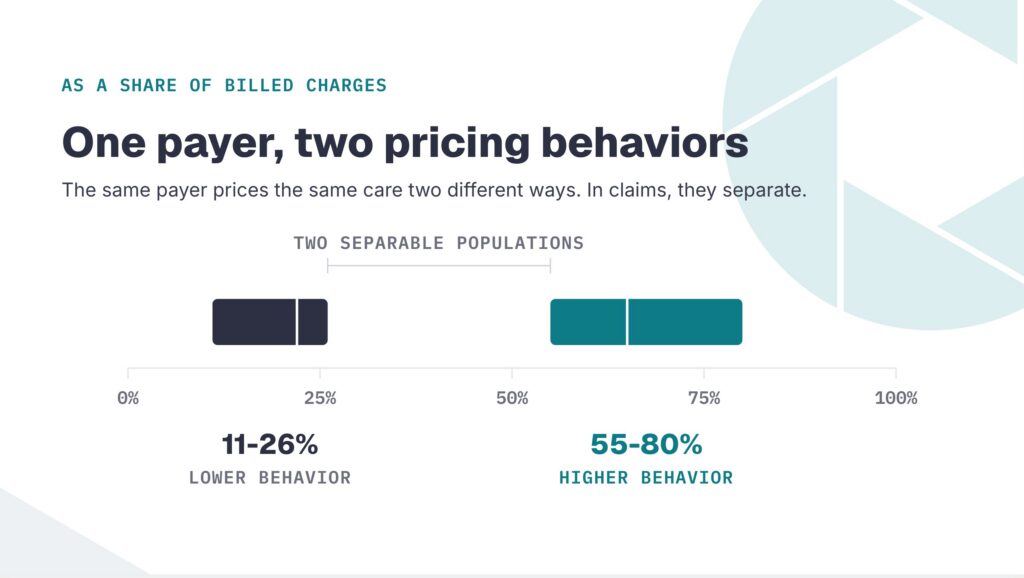
Out-of-network, the same payer group pays about $675 a day for one PHP admission and more than $2,900 a day for another.
Same payer group, same state, same level of care.
A facility that cannot tell which of those it is being priced under cannot forecast revenue within a wide margin, and the gap is large enough to decide whether an admission carries itself.
Nobody tells you which one applies. It is not on the verification, it is not on the authorization, and no payer transmits it on a remittance. But it is visible in adjudicated claims, and PayerLenz reimbursement benchmarks classify claims by the methodology the payer applied across more than 133,000 classified claim lines.
- The same payer group can pay several times more for one admission than another at the same level of care in the same state.
- The reimbursement methodology behind a claim is what separates them, and PayerLenz keeps each methodology separate rather than blending them.
- No payer reports which basis it used. The split is inferred from the distribution of paid percentages in adjudicated claims.
- The labels U&C, MRC1, MRC2, MNRP, and NAP are payer program names, not payer-reported fields.
What the Claims Actually Show
The clearest way to see it is inside a single payer group. For out-of-network PHP in one state, the median allowed amount runs about $675 a day under one home-plan cluster and more than $2,900 a day under another. Same payer group, same state, same level of care.
That spread is not noise and it is not an outlier. It is what happens when claims that were priced under different reimbursement methodologies are read as though they were one population. PayerLenz keeps each methodology separate in every result for that reason, because blending a Medicare-multiple plan with a usual-and-customary plan produces a number that matches no real claim.
Reading the distribution rather than an average is what makes the difference visible. The most-likely rate starts from the all-time median and moves toward the recency-weighted median, and the P25, P50, P75 and P90 spread around it shows the range real claims actually occupy.
Nobody Reports the Pricing Basis
This is the part that surprises people, and it is worth being exact about it. A remittance tells you what was allowed and what was paid. It does not carry a field naming the methodology the plan used to arrive at that figure.
So the basis is not looked up. It is inferred, by observing that claims from a single payer in a single state at a single level of care do not form one distribution. They form two, with a gap between them.
The methodology behind a claim is not transmitted by the payer, so it is derived from the claims themselves and stored with the sample size behind it. Where the evidence does not support a determination, the field is left empty rather than guessed at.
This matters for how any figure here should be read. The claim is not that a payer has declared a method and PayerLenz reports it. The claim is that two pricing behaviors are separable in adjudicated claims, and that each behaves consistently enough to forecast against. Anyone stating a definitive payer methodology sourced to claims data is overclaiming.
What the Labels Are and Are Not
The five names attached to these behaviors come from payer program terminology rather than from the data. Their status differs, and conflating them is where most published explanations go wrong.
An industry construction with a settled meaning. The plan pays based on what providers in the same geographic area typically charge for the same service, drawn from a third-party charge database rather than from a government rate. This one is genuinely defined outside of any single payer.
Cigna program terminology. Published plan documents describe Maximum Reimbursable Charge as the lesser of the provider’s normal charge or a percentile of area charges from third-party databases. What separates tier one from tier two is not published, and PayerLenz treats them as two separately observable behaviors rather than two defined formulas.
A UnitedHealthcare program name, referenced in that payer’s own parity disclosures alongside a sibling program called ENRP. The ceiling it applies is set in plan documents and is not published at program level.
An Aetna label that appears throughout claims data as an opaque token. What it stands for is not documented in public payer materials. What can be said is that the NAP claim population behaves as a distinct, lower-paying methodology, which is why PayerLenz reports it separately rather than folding it into the others.
Which Payers This Applies To
The separation is computed for Aetna, Cigna, UnitedHealthcare, and the Blue family. For other payers the field is deliberately empty rather than guessed at.
That is a limit worth stating rather than hiding. A pricing behavior can only be inferred where there are enough claims from one payer, state, and level of care to show two distributions instead of noise.
Blue Cross Blue Shield is handled differently again, because it is a federation rather than a single payer. A benchmark request for a Blue plan without an alpha prefix returns no result at all, on the grounds that blending every Blue sub-plan into one average would produce a figure describing no plan that exists.
What This Changes at Intake
The behavior is not knowable in advance with certainty. The range it falls in usually is.
Record the plan rather than the payer brand, and where the payer surfaces a program name, record that too. Then read the expected range against claims that share those characteristics rather than against a fee schedule or a prior admission that felt similar.
Federal parity rules give this some leverage as well. Plans must be able to show comparability between behavioral health and medical benefits, which makes out-of-network methodology a documented and requestable thing rather than a permanent black box. The CMS parity guidance sets out what a plan must be able to produce.
Where the electronic response is ambiguous and the admission is high in value, a call to the payer is worth its cost. Below that threshold it usually is not, and the range from comparable claims is the better tool. Medicare rates that some pricing bases reference are published by CMS.
Do Payers Tell You Which Pricing Method They Used?
No. A remittance reports the allowed and paid amounts without naming the methodology behind them. The basis has to be inferred from how claims from that payer, state, and level of care distribute.
What Is the Difference Between MRC1 and MRC2?
Cigna publishes the shared mechanism, the lesser of the normal charge or a percentile of area charges, but does not publish what separates the tiers. In claims they behave as two distinct populations, which is why PayerLenz keeps them separate rather than reporting them as one.
What Does NAP Stand For?
It is not documented in public payer materials. It appears in claims as a payer program name attached to a lower-paying methodology, and PayerLenz reports it as a separate methodology rather than blending it with the others.
How Many Claims Support This?
More than 133,000 claim lines carry a methodology classification, within a pool of more than 500,000 adjudicated claims. No figure is published without its claim count beside it, and no externally visible cell is built from fewer than 11 matched claims.
Start free with 15 historical searches at signup. No credit card required.
Get 15 Free Searches