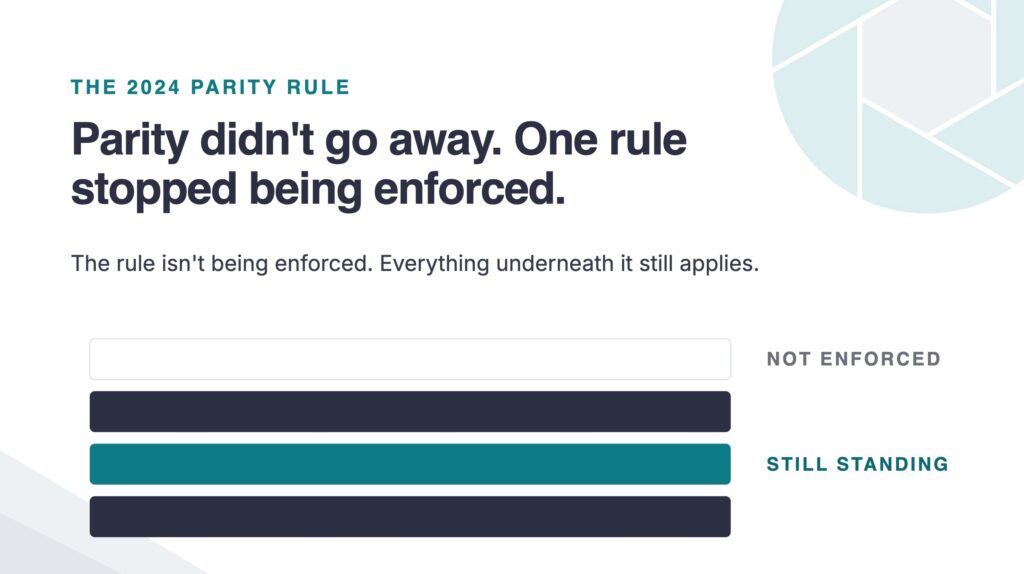
Somebody will tell you the new parity rule strengthened your position on out-of-network behavioral health. It is worth knowing that the rule they mean is not currently being enforced.
That is not the same as parity going away. The statute stands, the earlier regulations stand, and one requirement that gets attributed to the 2024 rule was never part of it and is unaffected.
The distinction matters operationally, because it changes which arguments hold weight and which rest on something that is presently paused. It also does not change what the claims show, which is what a reimbursement benchmark search is for.
- The Departments announced a nonenforcement policy covering the 2024 MHPAEA final rule.
- The parity statute and the earlier regulations were not paused and still apply.
- The requirement to prepare comparative analyses of non-quantitative treatment limitations is statutory and still stands.
- Providers are not the regulated party, so leverage here is indirect and evidence-driven.
What Changed, and What Did Not
The Departments of Labor, Health and Human Services and the Treasury announced that they would not enforce the 2024 final rule, and signalled a reconsideration of the broader enforcement program.
What was not paused is the parity requirement itself. The CMS parity guidance sets out the underlying obligation that mental health and substance use benefits be treated comparably to medical and surgical benefits, and that obligation predates the 2024 rule by many years.
The operative regulations sit at 45 CFR 146.136, which is the text to read if you want the actual standard rather than a summary of what a paused rule would have added.
The Requirement People Attribute to the Wrong Rule
Group health plans have to prepare and document comparative analyses of their non-quantitative treatment limitations. That obligation came from separate legislation, not from the 2024 rule, and the nonenforcement policy does not touch it.
This is the most commonly misattributed piece of the whole picture. A conversation that opens by conceding the requirement is paused concedes something that is not true.
This is a description of the current regulatory position, not legal advice, and the position is moving. Confirm the status with counsel before relying on any of it in a dispute or a payer conversation.
What Any of This Means for a Treatment Center
Start with an uncomfortable point. Parity obligations sit on plans and issuers, not on providers. A facility is not the regulated party and cannot enforce the rule directly.
What a facility has is evidence and standing to support the member. Documentation of how a plan treated a behavioral health admission, against how it treats comparable medical and surgical care, is the raw material for an appeal a member brings.
Non-quantitative treatment limitations are where this usually lives in practice: authorization requirements, level-of-care criteria, network composition, and how out-of-network benefits are actually administered. Several of those show up in ordinary verification work before they ever become a dispute.
Where the Operational Evidence Comes From
Carve-out arrangements are a network-composition question in disguise. When behavioral health benefits are administered by a separate organization with a separate network, that structure is visible on the verification, as the carve-out that answers wrongly describes.
Authorization requirements are captured on the same response, which is why a real-time eligibility check that records prior-authorization indicators is worth keeping on file rather than reading and discarding.
And what a plan has actually allowed for comparable admissions is a claims question. Reading it as a distribution with its support attached, in the way a trust score describes, is the difference between a documented pattern and an impression.
How to Talk About It Without Overstating
Say what is in force and what is paused, in those terms. A payer’s compliance team knows the difference, and a claim that leans on the paused rule invites a correction that costs you the rest of the conversation.
That precision is worth more than the extra leverage the overstatement would have bought. It is also the version a billing director can use without needing to relitigate the premise.
- Distinguish the statute from the paused 2024 rule when you cite either.
- Keep the verification record, including authorization and carve-out indicators.
- Support the member’s appeal rather than asserting a provider right you do not have.
- Re-check the regulatory position before relying on it.
- Do not describe the 2024 rule as currently enforceable.
- Do not assume the comparative-analysis requirement went away with it.
- Do not treat a parity argument as a substitute for a documented clinical case.
- Do not take a regulatory position from a vendor summary, including this one, without checking it.
The Short Version
The 2024 rule is paused. Parity is not. The comparative-analysis requirement is statutory and unaffected, and a facility’s role in all of it is to hold better records than the dispute requires.
Is Mental Health Parity Still the Law?
Yes. The statute and the earlier regulations remain in force. What is paused is enforcement of the 2024 final rule, which would have added to the existing framework rather than replacing it.
Do Plans Still Have to Do NQTL Comparative Analyses?
That requirement came from separate legislation rather than from the 2024 rule, and the nonenforcement policy does not remove it. It is the piece most often attributed to the wrong rule.
Can a Facility Enforce Parity Directly?
No. The obligations sit on plans and issuers. A facility’s practical role is documentation and support for a member’s appeal rather than direct enforcement.
Will the 2024 Rule Come Back?
The Departments signalled reconsideration rather than a fixed outcome, so the position is genuinely unsettled. Treat any summary, including this one, as current only as of when it was written.
Start free with 15 historical searches at signup. No credit card required.
Get 15 Free Searches