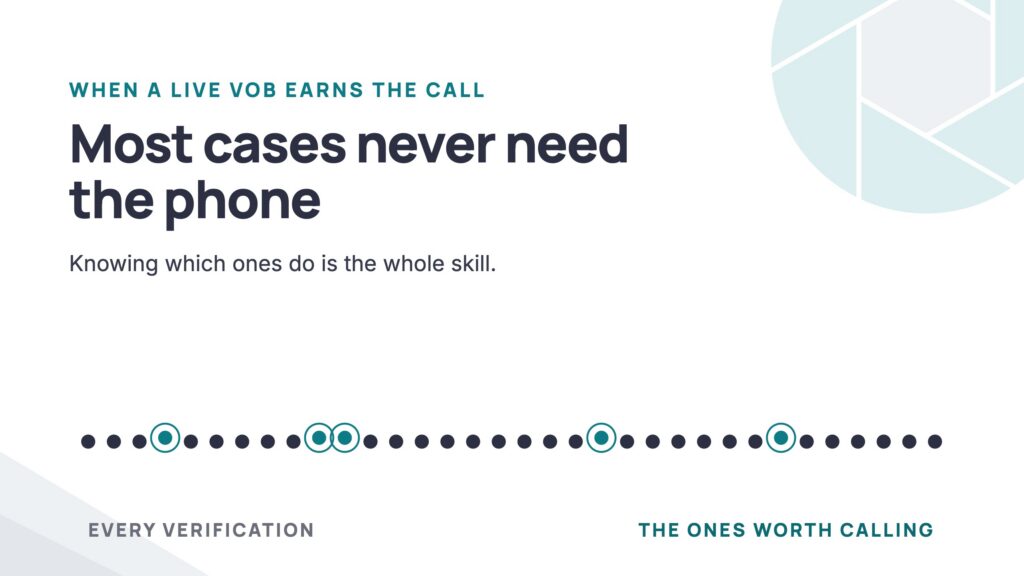
A verification team can work every case by phone. It will be thorough, it will be slow, and it will become the reason admissions cannot answer a family inside an hour.
The same team can work none of them by phone. It will be fast, and it will occasionally hand a family a number drawn from a response that never contained the answer.
The useful question is not which approach is better. It is which cases earn the call, and the PayerLenz Live VOB service exists for the ones that do.
- Electronic eligibility handles most behavioral health verifications well.
- Four case types reliably do not resolve electronically, and they are identifiable up front.
- A worked verification is priced per delivered result, so the cost of a call is knowable before it is placed.
- Treating every case as a phone case is how a verification team becomes the bottleneck on admissions.
What the Electronic Check Settles on Its Own
An eligibility request and response is a structured transaction between your system and the payer, governed by the X12 transaction set standard. CMS maintains its own overview of the standard transactions that these exchanges are built on.
For most admissions it settles the question. Coverage status, deductible and out-of-pocket detail in and out of network, behavioral health cost-share, prior-authorization indicators, and carve-out signals all come back in seconds.
That is a real answer, and running it first is not a compromise. It is the step that tells you whether a call is needed at all.
The Four Cases That Earn a Call
Limited electronic responses. The payer confirms active coverage and leaves the fields that matter to behavioral health blank. A clean-looking response with nothing in it is not a verification.
Carve-outs. The medical plan and the behavioral health administrator are not the same organization, and the team needs to establish who owns the benefit before anything is quoted. Detecting one is fast; resolving an unclear one is not.
Complex out-of-network plans. The benefit structure, the reimbursement methodology, or the authorization path cannot be resolved from a portal response alone.
High-stakes admissions. The benchmark has limited supporting data, the expected range is wide, or the value of the admit is high enough that being wrong is expensive. This is the case where a low trust score should change the workflow rather than just be noted.
A worked verification returns what the payer said on the call. It does not commit the payer to an amount, and no verification predicts what a specific claim will be allowed.
What the Call Costs, and When You Pay for It
Live VOB is priced per completed verification at $39.99 per delivered VOB on any paid plan. Billing happens when the finished worksheet reaches your account, not when the request is submitted.
That pricing shape matters more than the figure. No retainer, no minimum volume, and no per-seat surcharge for the verification team’s work means the decision to call is a per-case decision rather than a budget commitment made in advance.
It also makes the arithmetic simple at intake. Set the threshold where the cost of the call is trivial against the value of being wrong, and the four case types above will sit above it almost every time.
What Comes Back
The completed worksheet carries the member and plan details confirmed during the verification, in-network and out-of-network benefit information, deductible and out-of-pocket totals with met and remaining amounts where the payer provides them, and behavioral health copay or coinsurance detail.
It also carries the things a portal response cannot: authorization requirements and relevant call findings, carve-out information identified during the work, and the call reference details captured by the specialist.
Reimbursement benchmark context is attached to the same document, matched by level of care, so admissions can read what the plan says and what comparable claims have paid without opening a second system.
Track It Instead of Chasing It
Requests enter a queue inside the account rather than an inbox. Status changes are visible in the platform and in-app alerts fire when a request advances or a result is ready.
The operational value of that is smaller than it sounds and larger than it looks. It removes the question of whether anyone called on this case, which is the question that costs a verification team an hour a day and costs admissions its credibility with families.
Where the Two Fit Together
Run the real-time eligibility check on everything. Read what came back, and escalate on the four triggers rather than on instinct, because instinct escalates whatever the last bad surprise was.
That division is what keeps an admissions team on the phone with families instead of with payers. It is also why the two products are built to hand off to each other rather than to be chosen between.
The underlying reason any of this is necessary is that a coverage answer and a payment answer are different questions, which is the subject of the question a VOB never answers.
- Run the electronic check first on every case, without exception.
- Escalate on the four triggers rather than on how the last case went.
- Set a value threshold above which a call is automatic.
- Keep the electronic response on the record even after a call.
- Do not phone every case because one response was thin.
- Do not proceed on a blank behavioral health field as though it were a zero.
- Do not treat a completed call as a commitment from the payer.
- Do not re-verify from memory when a patient calls back weeks later.
The Short Version
Electronic checks are not the cheap version of a phone call. They are the step that tells you which calls are worth placing, and the four cases above are the ones that reliably are.
When Should I Order a Live VOB Instead of Running an Electronic Check?
Run the electronic check first every time. Order the call when the response comes back thin or contradictory, when a carve-out is indicated but the administrator is unclear, when the out-of-network structure cannot be resolved from the response, or when the admission is valuable enough that being wrong is expensive.
What Does a Live VOB Cost?
It is priced per completed verification at $39.99 per delivered VOB on any paid plan, billed when the finished worksheet is delivered to the account rather than when the request is submitted.
Does a Live VOB Tell Me What the Claim Will Pay?
No. It returns what the payer stated during the call, with benchmark context attached. Neither of those is a commitment from the payer about a specific claim.
Can My Team See Where a Request Is Without Emailing Anyone?
Yes. Requests sit in a queue inside the account with visible status changes and in-app alerts when a request advances or a result is ready.
Start free with 15 historical searches at signup. No credit card required.
Get 15 Free Searches