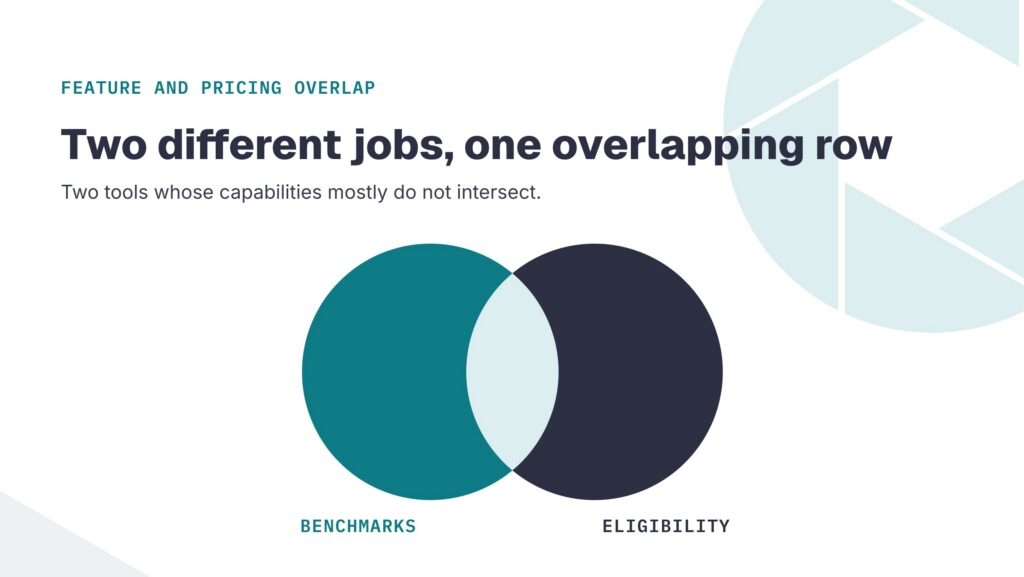
PayerLenz and VerifyTX get compared constantly and they are not really competitors. They overlap on one function and diverge on everything else, which makes “which is better” the wrong question and “which bottleneck do you have” the right one.
What follows uses each company’s own published pricing and product pages as of August 2026. Where VerifyTX wins a row, this says so.
- Both run real-time eligibility. Only PayerLenz attaches an expected reimbursement rate to it.
- VerifyTX is more built out on the eligibility side, with 1,700 or more payers, scheduled census re-verification, and claim status tracking.
- VerifyTX is cheaper per month at both published paid tiers.
- PayerLenz has a free entry point, but it includes benchmark searches rather than eligibility checks, so it is not a free version of the verification product.
The Actual Difference
VerifyTX confirms that coverage is active and returns the plan’s benefit structure. Deductibles, cost-share, exclusions, authorization requirements, and behavioral health carve-outs.
PayerLenz does that and attaches a benchmarked reimbursement estimate drawn from adjudicated behavioral health claims. So one answers whether the patient is covered and what the plan says. The other also estimates what the payer has historically paid.
Neither predicts a specific claim. Both are describing inputs to a decision rather than an outcome, which is worth saying plainly before any feature table.
Feature and Pricing Comparison
| PayerLenz | VerifyTX | |
|---|---|---|
| Reimbursement benchmark | Yes. Built from adjudicated claims across 250 payer groups in 20 states, from 500,000+ claims | Not offered |
| Real-time eligibility | Yes, with a benchmark attached to the result | Yes. Results in seconds, with mobile app access |
| Eligibility payer coverage | Not published | 1,700+ payers stated, including behavioral health carve-outs |
| Scheduled census re-verification | Not offered | Yes. Daily through monthly, with alerts when coverage changes |
| Claim status and denial tracking | AR Dashboard, built from your own uploaded claims history | Yes. Real-time claim status with denial prevention alerts |
| Vendor-run VOB call | Yes. Live VOB at $39.99 per delivered verification | Not offered. Self-service platform |
| Free entry point | Free tier at $0. 15 historical benchmark searches, 2 seats, no eligibility checks | No free tier and no trial |
| Entry paid plan | Essentials $399/month plus $200 one-time setup | Essentials $299/month plus $250 one-time setup |
| Next tier | Professional $665/month | Professional $579/month, or $483/month billed annually |
| Annual billing discount | Not published | Yes, roughly 17 percent |
| Data-contribution discount | Up to 25 percent off the plan fee each cycle | Not offered |
| Contract | Month to month | Month to month, cancel anytime |
VerifyTX figures are that vendor’s own published claims as of August 2026 and are not independently audited. PayerLenz figures come from its published pricing and product pages.
Where VerifyTX Is the Better Tool
If the bottleneck is confirming coverage quickly and repeatedly across a full census, VerifyTX is built for that job and PayerLenz is not.
Scheduled re-verification is the clearest example. Catching a lapsed policy mid-stay before it becomes an unpaid month is a specific and valuable function, and PayerLenz has no equivalent.
Its stated payer coverage for eligibility is also larger, and its claim status tracking runs on live claim data rather than on a history file you upload.
On price it is cheaper at both published tiers, and the annual option widens that gap further. A team whose problem is verification throughput should weigh that seriously.
Where PayerLenz Is the Only Option
If the bottleneck is not knowing what a payer will pay before admitting an out-of-network patient, no amount of verification capability solves it.
That gap exists because a verification returns the coinsurance percentage and not the allowed amount it applies to. The allowed amount is the figure that determines payment, it is set by the plan’s pricing method, and it is not part of what an eligibility transaction carries. The relevant transaction standards are maintained by X12.
PayerLenz closes that by reading adjudicated claims that share the patient’s payer group, state, level of care, and reimbursement method, and reporting the distribution with the claim count behind it.
The other genuine difference is Live VOB. When an electronic response comes back thin or a carve-out administrator is unclear, someone has to make the call.
PayerLenz will make it for you at a per-verification price, and VerifyTX leaves that with your staff.
Read the free tier carefully rather than as a free trial of the eligibility product. It includes 15 historical benchmark searches and no eligibility checks, so it demonstrates the benchmarking side and not the verification side. Comparing $0 against $299 is not comparing the same thing.
What to Ask Before You Buy Either
Both vendors will demo well. The questions that separate them are the ones about your own data and your own edge cases.
Ask what happens to your data if you leave. A verification history and a claims upload are both assets, and a tool that makes export awkward is more expensive than its monthly price suggests.
Ask how each handles a behavioral health carve-out specifically. Coverage that routes to a separate administrator is routine in this space.
A response from the plan that will not adjudicate the claim is worse than no response at all, because it looks like an answer.
Ask what the number on the screen is actually claiming. A coverage figure and a rate estimate are different kinds of statement, and any vendor presenting one certain rate for a specific admission is overstating what claims data supports.
Then ask for the retention and deletion policy in writing. PayerLenz holds eligibility results for 30 days and then permanently deletes them, with export available to keep a copy, which is a deliberate handling choice worth understanding before it surprises someone during an appeal.
The Honest Recommendation
Pick by bottleneck rather than by feature count.
- Verification throughput across a large census points to VerifyTX
- Rate uncertainty before an out-of-network admit points to PayerLenz
- Both problems at once is a real situation, and running both is a legitimate answer
- Price the setup fee and the annual option into any comparison, not just the monthly figure
- Do not read the free tier as a free version of eligibility verification
- Do not treat the benchmark as a guarantee of what a claim will pay
- Do not compare monthly prices without noting what each plan actually includes
- Do not assume one tool replaces the other, because the overlap is narrower than it looks
Plenty of teams will conclude they need a verification platform and separately need rate visibility. That is not a failure of either product. It is what happens when two tools solve adjacent problems well and neither tries to solve both.
Do PayerLenz and VerifyTX Do the Same Thing?
No. Both run real-time eligibility, but only PayerLenz attaches a reimbursement benchmark built from adjudicated claims. VerifyTX offers scheduled census re-verification and claim status tracking that PayerLenz does not.
Which One Is Cheaper?
VerifyTX, at both published paid tiers. Its Essentials plan is $299 per month against $399, and its Professional plan is $579 against $665, with a further discount for annual billing. Setup fees are comparable at $250 and $200.
Does PayerLenz Offer a Free Trial?
There is a free tier rather than a trial, and it includes 15 historical benchmark searches with no eligibility checks. It shows the benchmarking side of the product, not the verification side.
Can You Use Both Together?
Yes, and some teams reasonably do. One handles verification throughput, the other supplies the expected rate. They are not mutually exclusive.
Start free with 15 historical searches at signup. No credit card required.
Get 15 Free Searches