Most healthcare software gets built in the opposite order. A team raises money, picks a vertical, hires a few "domain advisors," and ships a product that looks right in a demo and falls apart the first time a carve-out shows up on a plan. Behavioral health billing is full of tools like that.
PayerLenz came out of the other direction. Revenue Logic is a white-glove revenue cycle firm built exclusively for behavioral health. We verify benefits, submit claims, work denials, and chase payers for treatment centers every day. Somewhere along the way we realized the most valuable thing in our shop wasn't the labor. It was the data underneath it: years of adjudicated claims showing exactly what each payer pays, for each level of care, in each state, under each reimbursement methodology.
Our clients asked us the same question every week.
"What is this payer actually going to pay?"
We could answer it because we had the claims history. Almost nobody else could. So we productized the answer.
The information exists, payers have it, and we think facilities should too.
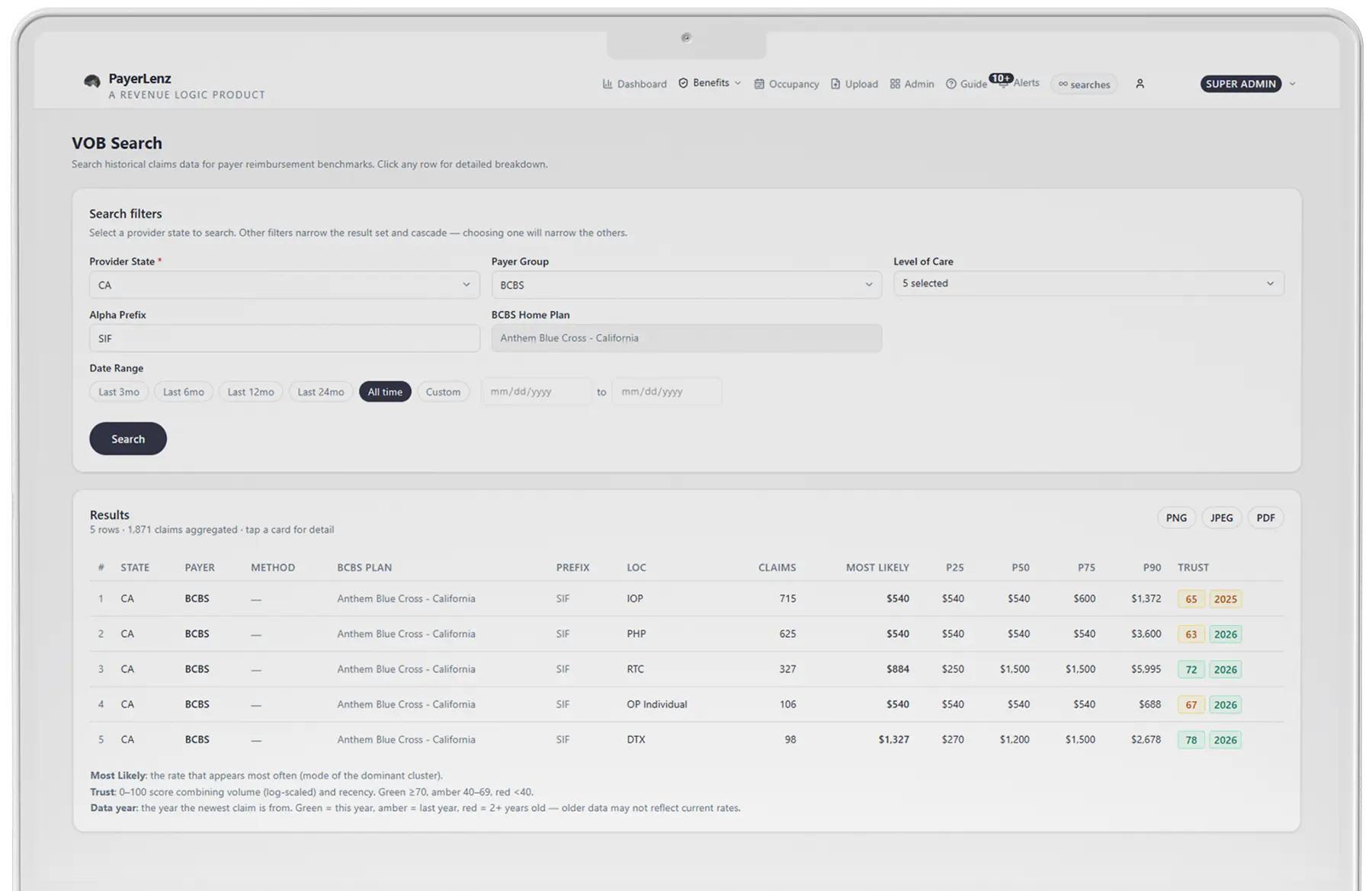
That's why every PayerLenz benchmark carries a trust score built from claim volume and recency, shows the full P25/P50/P75/P90 distribution instead of a single average, and links to a public methodology page. If the data behind a figure is thin, we tell you it's thin.
Carve-outs, single-case agreements, level-of-care authorization rules, BCBS alpha prefixes: this is a different discipline from medical billing, and a tool adapted from primary care will always read BH plans wrong. PayerLenz is behavioral health only, and it's going to stay that way.
Reimbursement benchmarks, real-time eligibility, live VOBs, and the AR dashboard are live today, covering 260+ payer groups across 21 states and growing. Full billing workflow management is in development, built on top of the rate data rather than bolted to the side of it. The goal is one platform where the entire behavioral health revenue cycle runs, and where the answer to "what will this pay?" is available at every step.
Kyle has worked behavioral health revenue cycle since 2012. He founded Revenue Logic and has spent over a decade inside the exact claims data PayerLenz is built on: the verifications, the payer behavior, the reimbursement patterns that only show up when you've billed the same payers across thousands of claims. When a facility asks why a benchmark looks the way it does, Kyle has usually worked the claim type himself.

Preston has spent his career on the other side of treatment-center economics, helping facilities grow census through digital marketing and admissions consulting, with more than 200 facilities served. He's watched programs spend heavily to generate an admit, then lose the margin on reimbursement they never saw coming. His work closes the loop between marketing spend, admissions, and what actually gets paid.
Between them, both halves of the business: getting patients in the door, and getting paid for the care.