PayerLenz Reimbursement Benchmarks

See what the payer paid before you admit.

Eligibility confirms that a benefit exists. It doesn’t tell you what the claim is likely to pay.

PayerLenz searches real, adjudicated behavioral health claims across 260+ payer groups in 21 states and growing. Filter for the payer, geography, level of care, and reimbursement methodology that match the case in front of you.

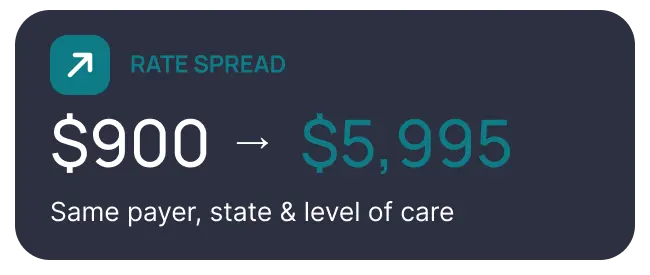
RATE SPREAD

$884 → $5,995  ·  same payer, state & level of care

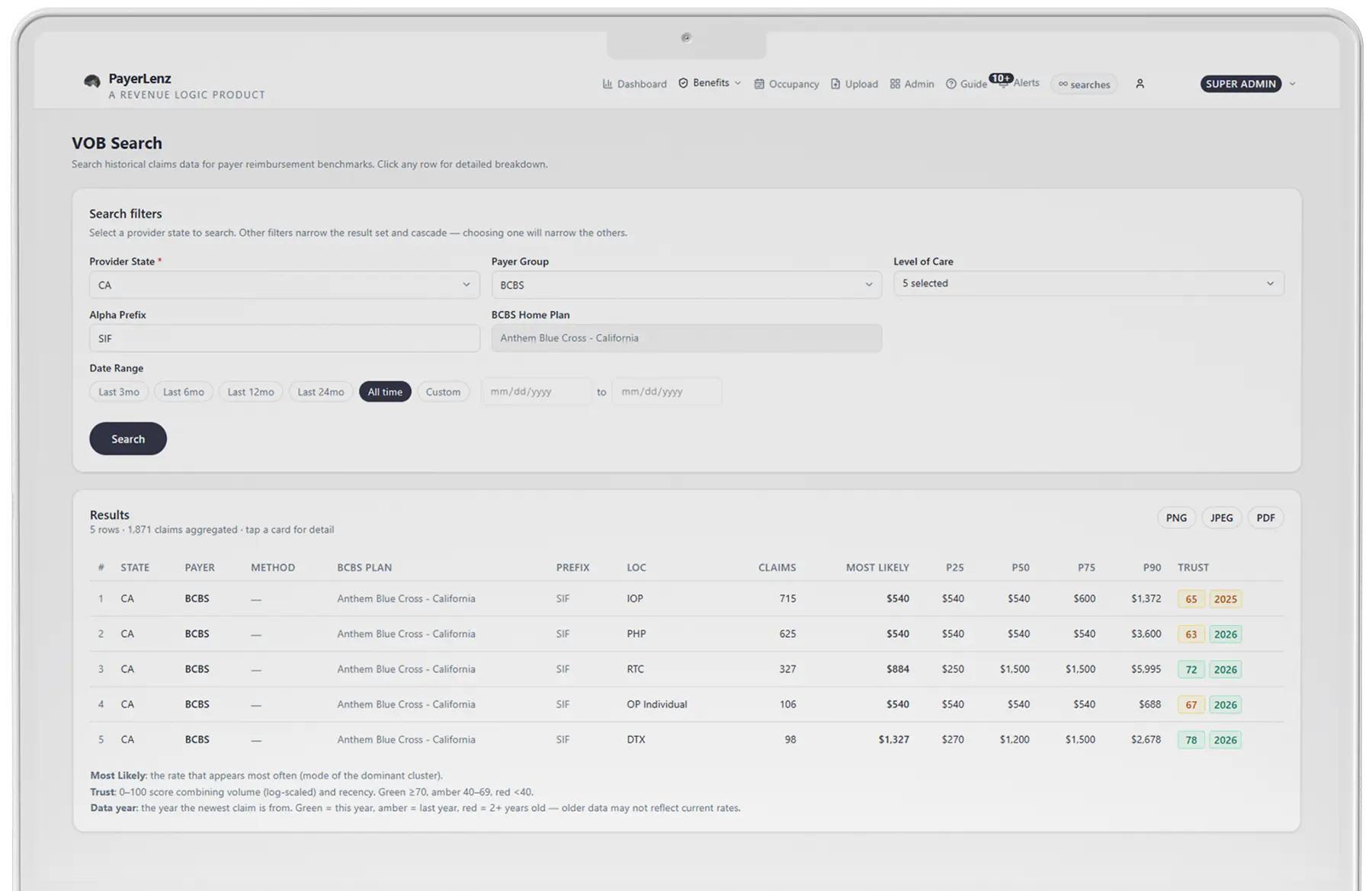
Benchmarks search and results screen

Visual placeholder · 16:9 · asset pending

One average hides the part you need to see

A payer doesn’t have one universal “behavioral health rate.” The result can change by home plan, product, state, level of care, and reimbursement methodology. A blended average flattens those differences into a number that may not describe any actual claim.

PayerLenz shows the distribution instead:

Result fieldWhat it tells you
Most-likely rateThe mode of the dominant cluster of matched claims — the rate this combination most commonly pays
P2525% of matched observations fall at or below this value
P50The median: half of matched observations fall at or below this value
P7575% of matched observations fall at or below this value
P9090% of matched observations fall at or below this value
Trust scoreHow much weight to place on the result, from supporting claim volume and recency

The percentiles describe the observed claims in the matched dataset. They aren’t a promise that a specific claim will pay at a specific point in the range.

Filter for the variables that move the payment

Payer group

Start with the payer responsible for adjudication, not a generic carrier label that combines unrelated plans.

State

Compare the claim with reimbursement observed in the relevant market. A rate paid in one state shouldn’t set the expectation in another.

Level of care

Keep detox, residential, PHP, IOP, and outpatient behavioral health services in the correct comparison set. The economics are different, and the benchmark should be too.

Reimbursement methodology

Out-of-network payment isn’t one formula. PayerLenz classifies each claim by the pricing methodology the payer applied and keeps them separate in every result:

  • U&C — usual and customary, keyed to billed charges
  • MNRP — maximum non-network reimbursement, keyed to a Medicare multiple
  • MRC1 / MRC2 — maximum reimbursable charge schedules
  • NAP — network access program pricing

Mixing these methodologies creates a benchmark that’s difficult to apply. PayerLenz keeps them visible, because a $2,300 U&C median and a $450 MNRP median can come from the same payer.

BCBS is resolved to the plan that matters

“BCBS” is not a sufficient payer match. Blue plans operate independently, and the member’s home plan can determine how a claim is priced and adjudicated.

PayerLenz resolves BCBS data by alpha prefix and home plan before it enters the benchmark — and a BCBS search requires the prefix, so a local result is never diluted by claims that share a brand but not a reimbursement structure.

Every number comes with evidence

Trust score

The trust score is a 0–100 figure built from two inputs:

  • Volume: the number of adjudicated claims supporting the selected payer, state, level of care, and methodology, log-scaled so the score rewards depth without letting one giant combination dominate.
  • Recency: the share of those supporting claims from the last 12 months.

A high score means the result has stronger support. A lower score doesn’t disappear behind a polished average. It tells your team to treat the benchmark as directional and put more weight on a live VOB or payer confirmation.

Year-over-year movement

Review how the matched reimbursement pattern has changed over time. A trend can show that a payer is tightening, holding, or moving before the change becomes obvious in your own AR.

Rate-cluster breakdown

Drill into any result to see the clusters behind the dollar figure. When the same payer runs more than one reimbursement basis across products, the breakdown shows each cluster’s share instead of blending them.

Read the full data methodology →

Use the result where the decision happens

At intake

Put a reimbursement range beside the eligibility response before staff, bed capacity, and clinical resources are committed.

During financial clearance

Give the team a defensible starting point for patient responsibility and expected payer reimbursement. Confirm patient-specific benefits separately.

In utilization and billing

Set one expectation across admissions, UR, and RCM. When the EOB arrives, compare it with a documented benchmark instead of a remembered payer anecdote.

In payer conversations

Bring a claim-backed distribution and trend, not “we think you used to pay more.”

Benchmarks versus patient-specific verification

QuestionReimbursement BenchmarkReal-Time EligibilityLive VOB
What has this payer paid for comparable behavioral health claims?YesBenchmark context shownBenchmark context attached
Is this patient’s coverage active?NoYesYes
What are this patient’s deductibles and out-of-pocket amounts?NoElectronic responseVerification worksheet
Does the plan require a payer call to clarify benefits?NoMay identify the issueA specialist works the call
Is the payment amount guaranteed?NoNoNo

Use a benchmark to establish a rate expectation. Use eligibility or a Live VOB to confirm the patient’s benefit structure. Neither replaces the payer’s adjudication of the eventual claim.

Built from claims. Not surveys.

PayerLenz benchmarks come from de-identified, adjudicated behavioral health claims contributed by Revenue Logic and participating facilities — more than 500,000 of them and growing. They aren’t self-reported rate surveys, fee schedules from unrelated specialties, or a single customer’s spreadsheet presented as a market.

The pool grows as accepted claims are contributed. More relevant, recent lines strengthen the benchmark your own team uses later.

Learn how contributions are handled →

See contribution discounts →

Stop finding out on the EOB.

Search the payer and level of care before the admission decision is made.